
Posted by Nureva on Aug 21, 2026, 9:02:35 AM
Most audio conference systems look simple from the outside: a microphone picks up voices in the room, a speaker broadcasts voices of remote participants and everyone hears the conversation. But how this happens is where systems differ dramatically, and making the wrong choice creates problems that are hard to fix after installation.
For IT managers responsible for equipping meeting rooms, classrooms and hybrid workspaces, understanding how audio conferencing systems work is the foundation for making the right purchasing decision. Room size, participant behavior, UC&C platform requirements and ongoing management overhead all create demands on the underlying technology. The type of system you choose determines not just how it sounds, but how long it takes to deploy, how much expertise it requires to manage and how much of your team’s time it will consume over its lifetime.
TL;DR: How do audio conference systems work?
Audio conference systems vary widely in how they capture, process and transmit voices, and the underlying technology determines performance, installation complexity and ongoing management overhead.
- Basic speakerphones work in small huddle rooms but fall short in larger spaces where participants move around or sit far from the device.
- Traditional multicomponent AV systems can perform well in large rooms but require a certified integrator, DSP programming, manual acoustic calibration and a service contract for ongoing maintenance.
- Integrated systems like Nureva® audio solutions deliver full-room microphone coverage with no DSP programming, no invasive ceiling work and installation in as little as 30 minutes, and they’re managed remotely (in this case, through Nureva Console).
For IT teams responsible for equipping meeting rooms, classrooms and hybrid workspaces, Nureva audio systems deliver pro AV performance without the complexity, cost or specialist overhead of traditional deployments.
Types of audio conferencing systems
Not all audio conferencing systems are built the same way. The type of system you choose determines the components required, the expertise needed to install and maintain it and how well it performs across different room sizes and use cases.
Basic speakerphones and all-in-one devices
Basic speakerphones and all-in-one conferencing devices are the simplest category of audio conferencing system. They are typically USB powered, plug directly into a room computer and require no specialist installation or configuration.
These devices work well in small rooms and huddle spaces where participants sit close together, but they have significant limitations in larger spaces and at scale:
- Microphone pickup is limited to a small radius around the device, leaving dead zones in larger spaces
- Audio quality degrades when participants sit far from the device or move around the room
- Remote management capabilities are minimal, making fleet-wide updates and monitoring difficult
- Systems are not designed for rooms where remote participants need to hear everyone clearly regardless of position
Traditional multicomponent AV systems
Traditional pro AV audio conferencing systems are built from discrete components, each sourced and configured separately. They are capable of high performance in large and complex spaces, but they require significant specialist involvement to deploy and maintain.
A typical traditional setup includes:
- Ceiling-mounted or tabletop microphone arrays with fixed pickup patterns
- A separate digital signal processor (DSP) requiring specialist programming for signal routing, gain structure and echo cancellation
- A separate amplifier and loudspeaker system
- Complex multi-cable routing between all components
- Manual acoustic calibration using specialist measurement equipment
- A certified AV integrator for installation, often taking multiple days per room
- A service contract and recurring technician visits for ongoing maintenance and updates
Integrated audio conferencing systems
Integrated audio conferencing systems consolidate microphones, speakers and processing into a small number of components. They are designed for IT deployment, with no DSP programming, no ceiling work and no specialist skills required.
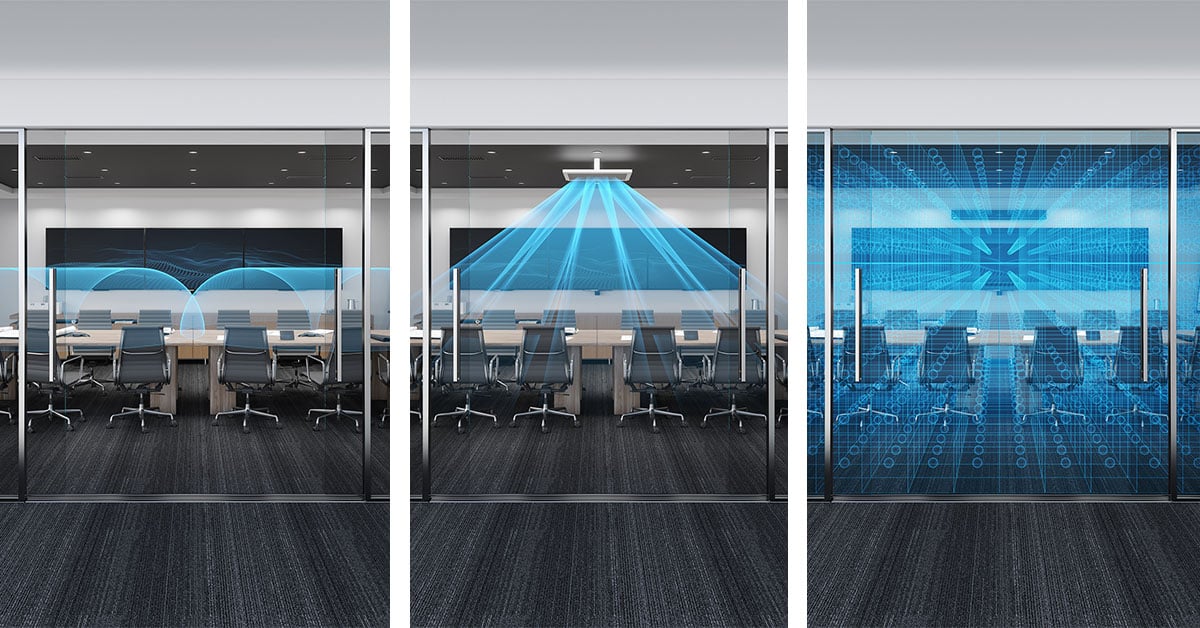
Nureva audio solutions are integrated systems powered by patented Microphone Mist™ technology, which fills the entire room with thousands of virtual microphones for full-room mic pickup regardless of where participants sit, stand or move. Key characteristics include:
- One or two wall-mounted microphone and speaker bars and a connect module covering rooms up to 35' x 55' (10.7 x 16.8 m) with the HDL series
- Two or four audio bars, optional microphone pods and a system hub covering rooms up to 40' x 60' (12.2 x 18.3 m) with the HDX series
- Built-in processing with continuous autocalibration and no DSP programming required
- Plug and play compatibility with Microsoft® Teams, Zoom, Google Meet™, Cisco Webex® and other UC&C platforms
- Remote management and monitoring via Nureva Console from a single cloud-based dashboard
- Installation in as little as 30 minutes with no special skills or tools required
Understanding audio conference system specifications
When evaluating audio conferencing systems, specifications tell you how a system performs in practice and whether it is the right fit for a given space. The following terms appear frequently in product documentation and are worth understanding before making a purchasing decision.
- Room coverage dimensions: The maximum floor area a system can cover with consistent microphone pickup. Measured in feet or meters (e.g., 30' x 30' or 9.1 x 9.1 m). This is one of the most important specifications for room matching — a system deployed in a space larger than its rated coverage area could result in dead zones where participants cannot be heard clearly.
- Microphone technology: The approach a system uses to capture voice. Beamforming systems use a limited number of physical microphones to create directional pickup patterns pointed at fixed positions. This can mean coverage gaps when participants move outside the beam’s focus, and it might require complex programming to avoid this issue. The more advanced approach fills the entire coverage area with virtual microphones, capturing voices regardless of participant position, direction or movement, without the need for complex tuning.
- Autocalibration: The ability of a system to automatically analyze a room’s acoustic properties and configure itself accordingly. Systems without autocalibration require manual acoustic calibration by a specialist using measurement equipment, typically taking several hours per room.
- Echo cancellation: A processing function that prevents the system’s speaker signals from being picked up by its microphones and transmitted back to remote participants as an echo. Effective echo cancellation is essential for natural-sounding conversations. Some systems use a fixed configuration set during installation, while others adapt continuously in real time.
- Noise suppression: The ability of a system to reduce unwanted background sounds such as HVAC equipment, projector fans and display cooling fans. Traditional systems apply post-processing filters to suppress noise after it has been picked up. More advanced approaches identify and preemptively ignore consistent noise sources before they affect audio quality.
- UC&C platform compatibility: Whether the system is certified for or compatible with your conferencing platform of choice. Certification by Microsoft Teams or Zoom confirms the system has been tested and validated for use with those platforms. Always verify compatibility before purchasing, particularly if your organization uses multiple UC&C platforms.
- Network requirements: Cloud-based management platforms require a steady internet connection. In some environments, specific URLs may need to be approved by an IT administrator before a device can connect to its management platform.
- Management interface: The software platform used to configure, monitor and update devices. Traditional systems may require on-site visits or a service contract for routine maintenance. Cloud-based management platforms allow IT teams to manage all enrolled devices remotely from a single dashboard.
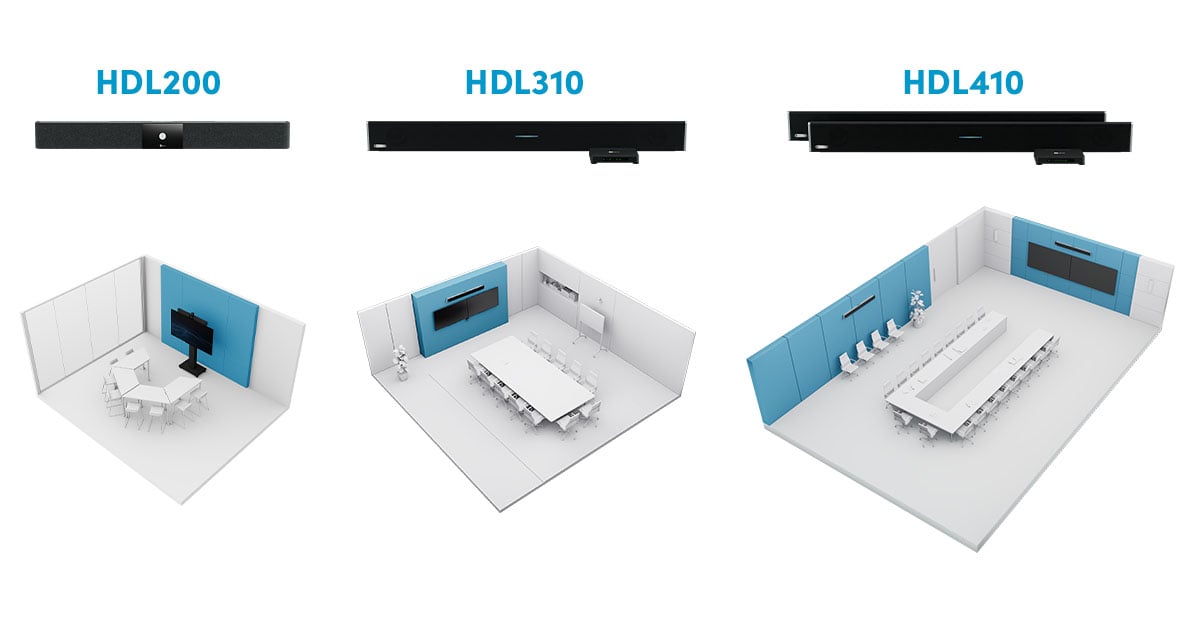
Nureva audio systems are available in configurations for rooms of all sizes. The HDL200 system covers medium-sized rooms up to 18' x 18' (5.5 x 5.5 m), the HDL310 system covers large rooms up to 30' x 30' (9.1 x 9.1 m) and the HDL410 system covers extra-large rooms up to 35' x 55' (10.7 x 16.8 m). The HDX series extends coverage to rooms up to 40' x 60' (12.2 x 18.3 m) in a modular solution with five configurations available.
Why Nureva is the best choice for audio conferencing systems
The core challenge with most audio conferencing systems is that performance and simplicity have traditionally been treated as trade-offs. Complex high-performance systems require specialist installation, DSP programming and ongoing technical support. Basic simple systems sacrifice coverage, leaving dead zones and inconsistent audio quality in anything larger than a small huddle room. For IT teams managing AV alongside a broader technology workload, neither option is ideal.
Nureva audio systems resolve that trade-off. Here’s how they compare to traditional approaches:
| Traditional multicomponent AV | Nureva integrated system | |
| Microphone coverage | Fixed pickup patterns, dead zones in larger spaces | Thousands of virtual microphones, full-room coverage |
| Calibration | Manual, requires specialist equipment and several hours | Continuous and automatic, no technician required |
| Installation | Certified integrator, multiday deployment | IT manager, as little as 30 or 60 minutes |
| Noise handling | Post-processing filters applied after pickup | Pre-processing via Intelligent Sound Targeting |
| Ongoing management | Service contract or on-site technician visits | Remote management with Nureva Console |
| Room flexibility | Reconfiguration requires technician intervention | Adapts automatically to layout changes |
For larger and more complex spaces, the HDX series brings the same plug and play simplicity to rooms up to 40' x 60' (12.2 x 18.3 m), with a modular architecture that adapts without specialist design or installation.
Hear the difference for yourself. Book a free 15-minute online demo and ask about taking a system for a test-drive in your own space.

